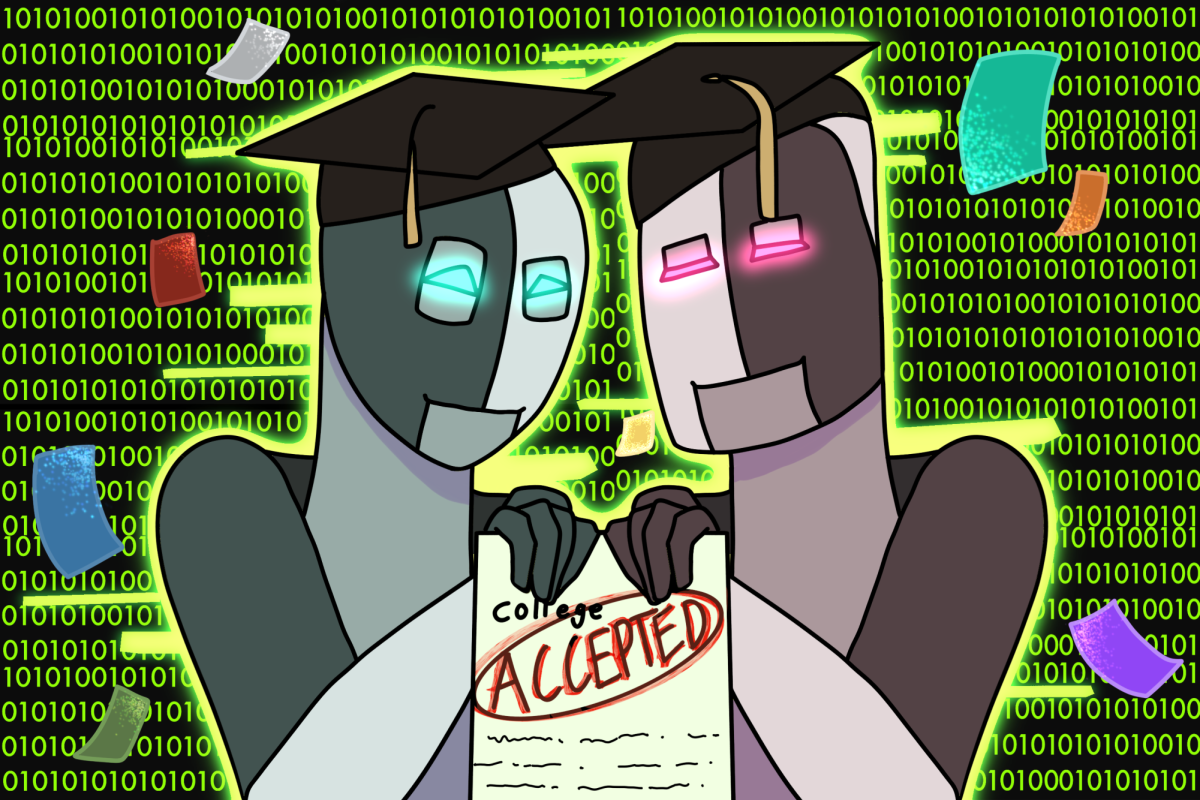
As artificial intelligence continues to expand, teachers and students worry about how technology can negatively affect society, education, and the future of the world.
“It [AI] is a useful study tool to make flashcards, or even to get a quick overview of math topics,” said freshman Cailyn Kindorf. “But some people rely on platforms like ChatGPT too much. When people become dependent on these AI apps, they are losing essential problem solving skills and creativity.”
Sophomore Siman Ouami agreed.
“I’ll use AI to help me brainstorm for projects in my English class, but I’ve noticed that I’m not really thinking deeply about the project topic. It’s almost like taking the easy road. My teacher’s job is to provoke me to think thoroughly and by using AI I’m not really learning or thinking about anything,” said Ouami.
Although AI can be an aid to students, it can have consequences, as well.
“If you were to get into a good college, but have been using AI on every assignment, then you are lying and hurting your education,” said freshman Alex Bumpus. “By using the same method of cheating in college, you will be punished heavily.”
Depending on the severity of the cheating offense, the school administrator may add the offense to that student’s permanent record.
According to the Wachusett Student Handbook 2025-2026, “Cheating and plagiarism in any form will not be tolerated. This includes, but is not limited to copying homework, papers, lab reports, quiz or test answers; acquiring or disseminating quizzes or tests before they are administered; or using information from the Internet or other outside sources without proper attribution.”
Punishments vary, according to the handbook.
“The administration reserves the right to impose other penalties up to and including removal from the course, removal from honor societies, and loss of eligibility for scholarships with “honor” as criteria.”
Colleges and universities have especially strict AI policies.
Brown University considers all forms of engaging in collaboration or unauthorized assistance on assignments to be violations of their Academic Code. According to the Brown University Academic Code penalties range “from reprimand, to suspension, dismissal, or expulsion from the University.”
In addition to the academic effects of AI, people begin to fear social media platforms’ new ability to create hyper-realistic photos and videos. Highly detailed AI videos have begun to take over platforms like YouTube, Instagram, and TikTok.
“I can normally tell when a video is created by AI because it almost looks like an animation, because the details are too clear and perfect. Sometimes body parts like fingers will morph into different forms,” said Ouami.
Some clues to AI created videos stand out more clearly.
“Another big giveaway is the small grey watermark in one of the corners,” said junior Marshall Streeter “but it can be tricky if nothing’s in any corner.”
Junior Colton Grensavitch said the new hyper-realistic videos can cause drama.
“AI’s ability to create fake videos is alarming. People might try to get others in trouble by creating false videos, and photos,” said Grensavitch.
The spread of AI scares students and teachers.
“AI is constantly getting updated and many people are overusing it. It’s scary how fast it’s developing,” said senior Luther Tadrous.
Assistant principal Josue Delgado said he has noticed the increasing rate of AI.
“Every day it becomes harder to decide whether whatever I’m seeing online is real or not. Sometimes I wonder what misinformation I’m being fed from social media and news publications,” said Delgado.
English teacher Sean Farrell said he worries about the growing strength of AI.
“AI is such a powerful tool to the community, but we keep making it more and more dominant. Soon enough it can do a lot of harm to our society,” said Farrell. “There are no boundaries as to what AI can do.”